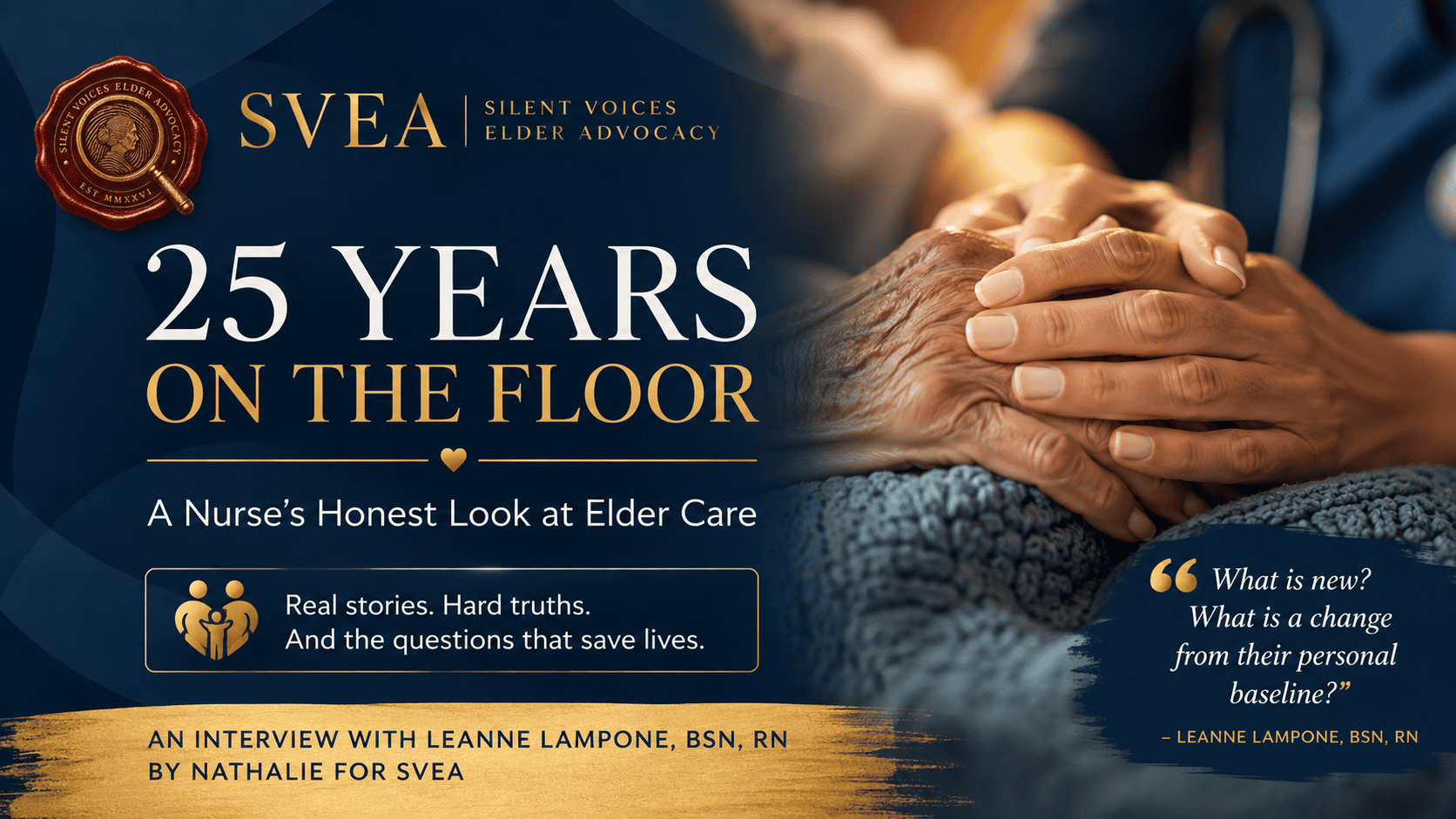
A Nurse’s Honest Look at Elder Care — an interview with Leanne Lampone, BSN, RN, by Nathalie for SVEA
This is something a little different for SVEA.
We don’t usually do interviews. Most of our work begins with medical records, regulations, complaints, research, or a question a family is trying desperately to answer.
For this first interview, I wanted to do something simpler. I wanted to sit across from someone who has spent years caring for older adults and ask her what she has seen.
So, over coffee, my friend Leanne Lampone, a nurse, and I talked about elder care, nursing, neglect, ageism, fear, staffing, and the moments that stay with you long after a shift ends.
Here is our conversation.
From an 18-Year-Old Volunteer to 25 Years on the Floor
Nathalie: Leanne, thank you so much for sitting down with me today. My audience and I have been so eager to talk to you. For anyone meeting you for the first time, how do you introduce yourself and your journey?
Leanne: It is so wonderful to be here with you! Well, I’m a Registered Nurse, and I hold degrees in both nursing and psychology. Believe it or not, I’ve been practicing for 25 years now.
Nathalie: Twenty-five years is incredible. You mentioned earlier that you spent some time in long-term care, too. How did a medical-surgical nurse end up falling into elder care so early on?
Leanne: It actually started when I was just 18. I took a job at a long-term care facility right near my home in Fort Lauderdale. At that age, it hit me instantly just how much extra patience, love, and genuine attention our elderly folks need. I worked alongside this wonderful RN charge nurse who kept pulling me aside and saying, “Leanne, you are so good with these patients. You really need to become a nurse.”
Nathalie: And she planted the seed!
Leanne: Exactly! So after I finished my psychology degree at the University of Florida, I went straight to the Medical College of Georgia for nursing. Even though I ended up on a hospital medical-surgical unit, I also did agency work that took me into all kinds of environments where I was constantly caring for older adults. Later, I even became a clinical instructor for a CNA program back in a long-term care facility.
Nathalie: Oh, wow. So you were the one supervising the next generation of caregivers?
Leanne: Yes! I was right there in the trenches with the students, teaching them everything from basic transfers and feeding to how to communicate with patients who are confused or hard of hearing. My main job was modeling compassion, but also stepping in the second I saw an unsafe practice to make sure they learned how to protect these vulnerable patients.
Room 402: The Lesson No Nursing Textbook Can Teach You
Nathalie: As healthcare workers, we both know the emotional toll this job takes. Is there one specific moment with an older patient that completely altered how you look at nursing?
Leanne: (Pauses) Yes, absolutely. I still remember a night shift where I received a report about an elderly lady with cancer in Room 402. The report said she wasn’t doing well. When I walked into her room during my rounds, my heart sank because she was completely alone. Her breathing was very shallow, though her vitals were stable. She looked up at me and just asked me to sit with her.
Nathalie: That breaks my heart. Did you stay?
Leanne: I told her I would stay with her every single chance I could get that night. She had absolutely no family. It was a long, heavy night, and honestly, I wasn’t sure she’d make it to sunrise. I just sat there, held her hand, and I actually cried right there with her.
Nathalie: That takes so much courage.
Leanne: It made me realize that no textbook or nursing class can ever teach you how to cry with a patient, or how to love them when they are at their absolute weakest. I just wanted to bring some kindness to her final hours. Right before my shift ended, she whispered, “Thank you.” She passed away later that day, but I’ll never forget her.
Red Flags and Body Language: The Silent Signs of Elder Neglect
Nathalie: That is beautiful, Leanne. On the flip side of that love, we have to talk about the harder realities. What are the immediate red flags you notice when an older adult, whether at home or in a facility, is being neglected or isn’t being watched closely enough?
Leanne: The most obvious signs are poor personal hygiene. You look for matted hair, dirty fingernails, strong body odor, or filthy clothing. I once took off a patient’s leg bandage to check a wound, and it was horrifying, the patient had unexplained bruises, severe weight loss, and the wound itself was actually full of maggots.
Nathalie: Oh, how awful…
Leanne: It’s devastating. And it’s not just the body, you have to look at their environment. Are there piles of garbage? Do they have actual heat or AC? Are there slippery rugs that are just waiting to cause a major fall? But beyond the physical stuff, look at their body language. When an elder is being mistreated, you may see a profound fear in the way they respond to people. They flinch, they clench their fists, their eyes shift constantly, their arms stay folded, and they completely withdraw because they are terrified of being touched.
Of course, none of these signs by themselves prove abuse or neglect. They are reasons to stop, look closer, and ask questions.
Nathalie: It’s a systemic issue, too. Nursing homes are constantly making headlines for neglect. When things go that wrong, who do you think is actually to blame? The overworked staff, the administration, or the broader system?
Leanne: Honestly? It’s all three. The floor staff are often completely overwhelmed with massive patient loads, meaning they have less time to step back and thoroughly evaluate anyone. Plus, nurse aides, who act as our primary eyes and ears, frequently don’t get enough hands-on, real-world training. Neglect often happens subtly, like ignoring a resident who is yelling out, or missing the fact that a quiet resident has suddenly completely withdrawn. Those behavioral shifts are usually early warning signs that a serious medical issue is brewing. When facilities cut budgets and staffing levels fall, there is less time for staff to notice problems, respond to residents, and prevent things from getting worse.
“Just Part of Getting Old”: The Dangerous Myth of Clinical Ageism
Nathalie: I’ve noticed in hospital settings that older patients often get treated very differently than younger ones. Have you seen that in your own practice?
Leanne: Frequently, yes, and usually for the worse. Older patients are often hesitant to speak up, ask questions, or advocate for themselves. As healthcare workers, we just don’t take the time to meet them where they are. Their dignity and privacy get completely taken for granted, especially if they don’t have a loud, insistent family member in their corner demanding answers.
Nathalie: Why do you think doctors and nurses miss these things? What are we dismissing as “just getting old”?
Leanne: Sudden memory problems, fatigue, pain, changes in appetite, or frequent falls. We look at an 85-year-old and say, “Well, they’re just aging.” Research has shown that ageism can affect how older adults’ symptoms are recognized and evaluated.
Nathalie: Really? What kind of errors?
Leanne: Conditions like delirium, depression, urinary tract infections, medication side effects, or even heart failure and certain cancers get swept under the rug as “normal aging.” Older adults don’t present symptoms the way a 30-year-old does. They might not run a classic high fever when they have a serious infection, instead, their only symptom might be a sudden functional decline or a bout of confusion. Clinicians must stop assuming decline is inevitable. Chronological age should never cost a person a thorough medical evaluation.
“We have to constantly ask: what is new? What is a change from their personal baseline?”
— LEANNE LAMPONE, BSN, RN
Tours, Red Flags, and De-escalating Fear Over Force
Nathalie: If a family is trying to choose a safe care facility for their mom or dad, what is your number one piece of advice?
Leanne: Go visit! Take a physical tour. Is the place actually clean, or does it just look modern on a website? Are there actual medical providers on site every single day? Talk to a resident or a family member if you can. Sit down with the director of nursing. And check the nursing home’s state ratings for red flags like increased falls, hospital readmissions, or state citations.
Nathalie: Let’s pivot to something that’s been in the news a lot lately. Arkansas and Florida both have laws that increase penalties for certain assaults or batteries involving healthcare workers. What do you think the general public gets wrong about the dangers nurses face, especially around older patients?
Leanne: My direct exposure to intentional workplace violence is thankfully limited. But from what I’ve observed, intentional, deliberate assaults happen far more frequently in high stress hospital areas like the Emergency Department than in long-term care.
Nathalie: Right, because in elder care, the root cause is usually very different.
Leanne: Exactly. In long-term care, when a patient is hitting, scratching, or throwing things, it is often driven by cognitive impairment, delirium, fear, pain, or another medical problem, which is more common than many people realize. They aren’t trying to maliciously hurt you, they’re terrified and disoriented. The priority can’t be treating them like a criminal, it has to be a safety and treatment approach focused on de-escalation, calming, and reassurance.
Nathalie: How do you safely handle a situation like that on the floor?
Leanne: Depending on the situation, you bring in a dedicated sitter, move the patient to a quieter room, dim the bright overhead lights, cut out loud noises, and limit how many staff members are rushing into the room. At the same time, you have to look for the medical trigger behind the agitation. Is it an undiagnosed urinary tract infection or pneumonia? Is it a metabolic imbalance, dehydration, or a reaction to a new medication? You treat the medical cause, you don’t punish the behavior.
Moving Toward a Non-Negotiable Standard of Care
Nathalie: To wrap up this conversation, Leanne, if you could change just one thing about how our healthcare system treats older patients, what would it be?
Leanne: I would make truly age-friendly, person centered care the non-negotiable standard rather than the exception. That means fixing staffing ratios so nurses actually have time to sit, listen, and properly assess their patients. It means mandatory geriatric competencies in every nursing and medical curriculum. And it means building care around the “4Ms” framework, focusing on what matters to the patient, their medication, their mentation, and their mobility.
Nathalie: It sounds like the roadmap is already there, we just aren’t using it everywhere.
Leanne: Exactly. We know these approaches help. We already know what works. We just need the will, the staffing, and the funding to make it routine.
Nathalie: Leanne, this has been incredibly educational and eye opening. I am so grateful you sat down to share this slice of your 25-year journey with us today. I certainly hope this isn’t the last time we chat!
Leanne: (Smiles) Thank you so much! I agree, there is still so much more for us to talk about.
By the time we finished talking, I kept thinking about something Leanne said earlier: “What is new? What is a change from their personal baseline?”
It sounds simple. It is. But sometimes the simplest questions are the ones healthcare forgets to ask.
After 25 years of nursing, Leanne has seen the exhaustion, the fear, the missed signs, the rushed moments, and the people who needed someone to slow down and notice. She has also seen what happens when someone does.
Our conversation reminded me that better elder care does not always begin with a complicated solution. Sometimes it begins with paying attention. Asking another question. Looking again. Refusing to dismiss a change because someone is old.
Leanne and I talked for a long time that afternoon. I left with more questions than answers, which I think is exactly where a conversation like this should leave us.

Nathalie Frias · CEHRS · CMAA
Nathalie Frias, certified electronic health records specialist and founder of Silent Voices Elder Advocacy, a platform for elder care accountability.
Her writing translates clinical documentation into evidence families and advocates can use to expose neglect, financial exploitation, and regulatory failures in long-term care. Learn more about Nathalie.
Worried about a loved one’s care?
SVEA’s Care Coordination Directory and Law Firm Directory can help you find resources near you, whether you’re choosing a facility or already facing a concern.
Explore SVEA’s Resources



Leave a Reply